

-
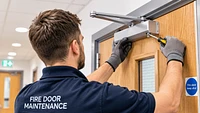
Reactive or Pre-Planned Fire Door Maintenance: Which Is Better for Your Building?
Most buildings have a fire door maintenance strategy, even if nobody has ever written it down.
For some, the strategy is simple: wait until something breaks, then call someone to fix it. For others, fire door maintenance happens on a fixed schedule, with doors serviced before small problems turn into compliance failures.
Both approaches keep doors working to some degree. But they produce very different results when it comes to cost, safety and the evidence a responsible person can show when asked.
So which approach actually makes more sense for your building?
What Is Reactive Fire Door Maintenance?
Reactive maintenance means responding to faults as they are reported. A resident notices a door is not closing. A tenant complains about a broken handle. A fire risk assessment flags damaged seals. Someone is called out, that specific problem is fixed, and the door is forgotten about until the next issue appears.
On paper, reactive maintenance looks cheaper. There is no ongoing contract and you only pay when something goes wrong. In practice, the picture is rather different.
What Is Pre-Planned Fire Door Maintenance?
Pre-planned fire door maintenance, often called PPM, is a scheduled programme of servicing carried out at agreed intervals. Rather than waiting for faults to be reported, certified engineers visit regularly to inspect, adjust and service each fire door, resolving defects before they compromise its performance.
The key difference is timing. Reactive maintenance responds after a door has already failed. Planned maintenance aims to stop it failing in the first place.
The Hidden Costs of Reactive Maintenance
The true cost of a reactive approach rarely shows up on a single invoice. It builds up quietly, in ways that are easy to overlook.
Doors Can Sit Non-Compliant for Months
Fire door defects are not always obvious. A painted-over intumescent strip or a gap that has slowly widened will not prompt anyone to pick up the phone. Under a reactive model, defects like these can go unnoticed until a fire risk assessment or inspection uncovers them, leaving the door underperforming for an unknown period.
Small Faults Become Expensive Ones
A loose hinge left unattended can cause a door to drop. That damages the frame, which affects the gaps, which compromises the seals. What could have been a quick adjustment becomes a much larger repair, or even a full replacement.
Emergency Call-Outs Disrupt Occupants
Unplanned repairs tend to happen at short notice, often in occupied buildings. In schools, care homes and residential blocks, that disruption matters to the people living and working there.
There Is No Consistent Evidence Trail
When maintenance happens in fragments, records tend to be fragmented too. If an enforcing authority or insurer asks how your fire doors are being maintained, a scattered collection of call-out invoices is far weaker evidence than a structured maintenance record.
Why Planned Maintenance Is Easier to Budget For
For facilities managers and housing providers, unpredictability is often the biggest frustration. Reactive costs spike without warning and are difficult to forecast.
A fixed fire door maintenance contract changes that. Costs become predictable, defects are resolved while they are still minor, and the lifespan of each doorset is extended. Over time, that reduces the need for unplanned replacements and the capital expenditure that comes with them.
What Does a Planned Maintenance Visit Cover?
Each visit is tailored to the building, its usage and its risk profile. At Capital Fire Doors, our BM TRADA certified engineers typically inspect, adjust and service:
- Door leaves and frames, checking for damage, warping and structural integrity
- Hinges and ironmongery, tightening or replacing fire-rated hardware where needed
- Self-closing devices, so each door closes fully and consistently
- Smoke seals and intumescent strips, replacing any that are worn, damaged or missing
- Perimeter gaps and clearances, adjusted to meet fire safety standards
- Fire-rated glazing and vision panels, including bead condition
- Certification labels, markings and fire door signage
Every visit is documented, with a written record of the works completed, defects identified, components replaced and the compliance status of each door serviced.
How Often Should Planned Maintenance Take Place?
Frequency depends on how hard your doors work. As a general guide, high-traffic buildings such as residential blocks, hospitals and schools typically need servicing every six months, while standard commercial buildings can often be maintained annually. In high-rise residential buildings with storeys over 11 metres, maintenance should also line up with the quarterly checks required for communal fire doors.
For more on inspection intervals, read our guide on how often fire doors should be inspected.
Is There Still a Place for Reactive Repairs?
Yes. Even the best maintenance programme cannot stop a door being damaged by a trolley, a removals van or a deliberate act. When that happens, a prompt fire door repair is exactly the right response.
The difference is that, within a planned programme, reactive fire door repairs become the exception rather than the strategy. They deal with genuine accidents, not with wear and tear that should have been caught months earlier.
What Planned Maintenance Looks Like in Practice
At a junior school in Leeds, our team carried out an in-depth inspection, replaced every faulty fire door, and then moved the school onto a six-monthly maintenance programme. Rather than waiting for problems to resurface, each visit keeps the doors compliant and the building safe for staff and pupils.
That pattern of inspect, remediate, then maintain is the most reliable way to keep fire doors performing over the long term, particularly in buildings with heavy daily use such as schools and education settings.
Choosing the Right Fire Door Maintenance Partner
Fire door maintenance is not general handyman work. Look for a contractor who:
- Holds third-party certification for fire door maintenance, such as BM TRADA Q-Mark
- Uses fire-rated components that are compatible with each doorset
- Provides documented records after every visit
- Can combine fire door inspections with maintenance, so defects are found and fixed by the same specialist team
- Can supply and install compliant replacements when repair is no longer viable
With over 40 years of passive fire protection experience, Capital Fire Doors delivers all of this through a single, accountable service.
Final Thoughts
Reactive fire door maintenance can feel like the cheaper option, but it often means doors spend long periods underperforming, small faults grow into costly repairs, and the evidence trail is patchy at best.
Pre-planned fire door maintenance takes a different approach. By servicing doors at regular intervals, it keeps them compliant between inspections, makes costs predictable, and gives responsible persons clear, documented proof that their duties are being met.
For most buildings, the right answer is a planned programme, backed by prompt repairs when accidents happen. If you would like to move from reacting to planning, get in touch with our team to discuss a maintenance schedule built around your building.