

-
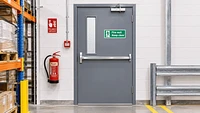
Steel Fire Door Mistakes to Avoid: 7 Costly Errors From Specification to Maintenance
Steel fire doors are built for the toughest jobs in a building. Plant rooms, warehouses, loading bays, risers and external escape routes all rely on doorsets that can resist impact, deter forced entry and hold back fire for extended periods.
Because they are so robust, steel fire doors are often assumed to be foolproof.
They are not.
A steel doorset can carry an FD120 rating, heavy-gauge galvanised skins and a full suite of fire-rated hardware, and still fail to perform if it is specified, installed or maintained incorrectly. If you are still deciding whether steel is right for your building, start with our guide on when to choose steel fire doors. If you have already decided, these are the mistakes worth avoiding.
1. Choosing the Fire Rating Without the Fire Strategy
Steel fire doors are available in a wide range of ratings, from FD30 through to FD240 for critical infrastructure. It can be tempting to pick a rating based on what seems sensible, or simply to go for the highest available.
Both approaches miss the point. The required rating should come from the building's fire strategy and compartmentation requirements. Under-specifying leaves a gap in protection. Over-specifying adds cost and weight, and can create knock-on issues with frames, hardware and the surrounding wall construction. Let the fire strategy decide, then select the doorset to match.
2. Treating the Door Leaf as the Whole Product
A fire rating belongs to the complete doorset as tested, not to the steel leaf on its own. The frame, hinges, locks, closers, intumescent strips, smoke seals and any glazing all form part of that tested assembly.
Mixing in hardware from another supplier, or swapping a specified closer for a cheaper alternative, can mean the installed door no longer reflects what was tested. Our steel fire doors are supplied with a full hardware suite, including fire-rated hinges, intumescent strips, smoke seals, self-closing devices and compliant ironmongery, so the doorset works as one system.
3. Ignoring Where the Door Will Actually Live
An internal plant room door and an external door on an exposed warehouse face very different conditions. Steel fire doors can be specified for external use, but only with the appropriate weatherproof seals and corrosion protection.
Specifying an internal-grade doorset for an exposed position can lead to corrosion, deteriorating seals and poor closing over time. Our steel doorsets use heavy-gauge galvanised steel skins, from 20 to 16 gauge, around a mineral wool core, with weatherproof seal options for external locations. Matching the specification to the environment from day one avoids early deterioration.
4. Leaving the Frame-to-Wall Junction Unprotected
A steel fire door is only as strong as the opening it sits in. One of the most overlooked weak points is the gap between the door frame and the surrounding wall.
If that gap is left open, filled with standard expanding foam that is not fire rated, or sealed with an untested product, fire and smoke can bypass the door entirely. The junction needs to be sealed with a fire-stopping solution suited to the wall type and the door's rating. This is where coordination between steel fire door installation and fire stopping and compartmentation becomes essential.
5. Making Modifications After Installation
Steel doors are frequently adapted after they go in. Access control readers are added, vision panels are cut in, new locks are fitted, or holes are drilled for cabling.
Each of these changes can compromise the doorset's fire performance if it is not covered by the manufacturer's test evidence and carried out by a competent installer. A hole drilled through a steel leaf for a cable can create a direct path for heat and smoke. Before any modification, check that it is permitted for that doorset and that it will be completed with compatible, fire-rated components.
6. Assuming Steel Doesn't Need Maintenance
Steel resists impact far better than timber, but that does not make a steel doorset maintenance-free. Steel doors are heavy, which places significant load on hinges and closers. In high-traffic areas, closers can lose adjustment, hinges can wear, and seals can become damaged or detached.
A steel door that no longer closes and latches fully offers very little protection, however robust the leaf may be. Regular fire door inspections and pre-planned fire door maintenance keep steel doorsets operating as intended throughout their lifespan.
7. Losing the Paperwork
Fire door compliance depends on evidence. Steel fire doors should be traceable to their fire testing, such as BS EN 1634-1 or BS 476 Part 22, along with the relevant UKCA or CE marking.
When labels are painted over, documentation is not handed over at practical completion, or records go missing during a change of ownership, it becomes far harder to prove a door is what it claims to be. Keep test evidence, installation records and maintenance history together, and make sure certification labels stay visible and intact.
Where Commercial Steel Fire Doors Make the Biggest Difference
Commercial steel fire doors are particularly valuable in industrial and warehousing facilities, plant rooms, healthcare environments, schools with heavy footfall, and residential buildings where communal entrances or plant rooms need higher ratings than timber can provide. In each of these settings, the doorset faces demanding conditions, which makes getting the details right even more important.
FD120 steel fire doors are commonly specified for high-risk environments, while FD240 doorsets are available for critical infrastructure. Where steel is not the best fit, timber fire doors or aluminium fire doors may offer a better balance of performance and appearance.
Final Thoughts
Steel fire doors offer outstanding durability, security and fire resistance, but only when the whole picture is right. The rating needs to come from the fire strategy, the doorset must be installed as a complete tested assembly, the opening around it must be properly fire stopped, and the door has to be maintained and documented throughout its life.
Most steel fire door failures are not caused by the steel itself. They are caused by the decisions made around it.
Capital Fire Doors supplies, installs and maintains certified steel fire doors across London and the UK, backed by over 40 years of passive fire protection experience. To discuss the right doorset for your building, speak to our team today.