

-
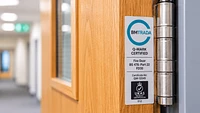
What Does BM TRADA Certified Actually Mean for Your Fire Doors?
Spend any time researching fire door contractors and you will see the phrase "BM TRADA certified" almost everywhere. It appears on websites, tender documents, vans and quotations.
But what does it actually mean? What has been certified, by whom, and what does it prove about the work being carried out in your building?
For building owners, facilities managers and responsible persons, the answer matters. Certification is only valuable if you know what it covers, and what it does not.
Who Are BM TRADA?
BM TRADA is an independent certification body, now part of the global testing and certification group Element. It is accredited by UKAS, the UK's national accreditation body, to run third-party certification schemes across the fire and building sectors.
The key word is independent. BM TRADA is not a manufacturer and it is not a contractor. Its role is to assess whether products and companies meet a defined standard, and to keep checking that they continue to do so.
What Is the BM TRADA Q-Mark Scheme?
Q-Mark is the name of BM TRADA's family of certification schemes. For passive fire protection, separate Q-Mark schemes cover:
- Fire door and doorset manufacture
- Fire door installation
- Fire door maintenanc
- Fire stopping installation
This distinction is important. A company can be certified under one scheme without being certified under another. A manufacturer certified to make fire doors is not automatically certified to install them, and an installer is not automatically certified to maintain them.
What Does Third-Party Certification Actually Prove?
Anyone can describe themselves as competent. Third-party certification means an independent body has checked.
Under the Q-Mark installation and maintenance schemes, companies must complete BM TRADA training and a written examination, work to documented procedures, and remain subject to ongoing auditing. Certification is not a one-off badge; it has to be maintained.
For a client, that is the real value of appointing a third-party certified fire door installer. It provides something self-declared competence cannot: independent evidence that the contractor understands how fire doors should be installed or maintained, and that their work is open to external scrutiny.
Certified Products and Certified Installation Are Not the Same Thing
This is where many buildings get caught out. A fire door can leave the factory fully certified, with the correct labelling and test evidence behind it, and still fail to perform once it is in the building.
Why? Because a fire door's performance depends on how it is installed. Incorrect gaps, unsuitable hinges, poor fixing into the wall, missing intumescent protection or the wrong closer can all undermine a certified doorset. Certification on the product proves the door can perform. Certified installation gives confidence that it will perform where it has been fitted.
The same principle applies throughout the door's life. A doorset installed perfectly can be compromised by a later repair that uses incompatible components. That is why certification for maintenance matters just as much as certification for installation.
Why BM TRADA Certification Matters for Responsible Persons
Under the Regulatory Reform (Fire Safety) Order 2005, the responsible person must ensure fire safety measures, including fire doors, are maintained in efficient working order and good repair. In practice, that means the work needs to be carried out by people with the right competence.
BM TRADA certification is not a legal requirement in itself. However, appointing a third-party certified contractor is one of the clearest ways to show you have taken reasonable steps to appoint someone competent. It also puts you in a stronger position with insurers, fire risk assessors and enforcing authorities, who increasingly expect to see evidence of competence rather than assurances.
How to Check a Contractor's BM TRADA Certification
Because the phrase is so widely used, it is worth verifying any claim before appointing a contractor. A few simple checks go a long way: Ask for the certificate itself, rather than relying on a logo on a website
- Check the scope, so you know whether it covers installation, maintenance or both
- Confirm the certificate is current and held by the company actually doing the work
- Ask what documentation you will receive, such as installation or maintenance records for each door
- If in doubt, confirm the details directly with BM TRADA
Common Misunderstandings About BM TRADA Certification
A few misconceptions come up again and again:
- "The doors are BM TRADA certified, so the installation must be too." Not necessarily. Product certification and installation certification are separate.
- "Certified once means compliant forever." Doors still need regular fire door inspections and maintenance to stay compliant.
- "Any contractor using certified products is a certified contractor." Certification belongs to the company and its processes, not just the products it buys.
Many of the failures inspectors find, such as excessive gaps and missing seals, trace back to installation and maintenance rather than the door itself. Our article on the most common failures found during BM TRADA fire door inspections explores these in more detail.
How Capital Fire Doors Works Under BM TRADA Certification
At Capital Fire Doors, BM TRADA fire door certification sits at the heart of how we work. Our fire door installation and pre-planned fire door maintenance services are delivered by BM TRADA Q-Mark accredited teams, and our inspections are carried out by BM TRADA certified inspectors.
That approach scales. When we inspected more than 15,000 fire doors across 49 accommodation blocks for the University of Southampton, every inspection followed BM TRADA Q-Mark standards. Alongside our BM TRADA certification, we are CHAS and Constructionline Gold accredited, backed by over 40 years of passive fire protection experience. You can find out more about our team and accreditations, or get in touch to discuss your building.
Frequently Asked Questions (FAQs)
What does BM TRADA certified mean?
BM TRADA certified means a company or product has been independently assessed by BM TRADA, a UKAS-accredited certification body, against a defined standard. For fire door contractors, it usually refers to Q-Mark certification for installation or maintenance, which is subject to ongoing auditing.
Is BM TRADA certification a legal requirement for fire doors?
No. UK law does not require BM TRADA certification specifically. However, responsible persons must make sure fire door work is carried out competently, and third-party certification is one of the clearest ways to demonstrate that competence.
What is the difference between BM TRADA and Q-Mark?
BM TRADA is the certification body. Q-Mark is the name of its certification schemes. For fire doors, separate Q-Mark schemes cover manufacture, installation and maintenance, so it is important to check which scheme a company is certified under.
Does a BM TRADA certified fire door stay compliant forever?
No. Certification shows a door was manufactured or installed correctly, but daily use causes wear over time. Regular inspection and maintenance by a competent specialist are needed to keep the door performing as intended.